
Martijn van der Meer, Roy Porter Prize Winner 2021/22
Winning the Roy Porter Student Essay Prize is fertile soil for imposter’s syndrome.
When I submitted my manuscript in January 2022, I didn’t have high expectations. The piece was based on the first chapter of my master’s thesis on the conceptual history of heredity in Dutch interwar public health discourse. As I hadn’t been able to land on a PhD position right after my master’s, rewriting that chapter into a more mature manuscript had been my way of staying connected to writing history. When I finally managed to figure out the point of the manuscript with the help of my supervisors—so that it went beyond just being a thorough description—I saw the call for submissions for the prize. It would be an opportunity to tie up loose ends and test the waters, I figured.
I crossed my fingers and hoped for feedback on why the manuscript might fall short, so that I would be able to develop it further and submit it as an article at a later point. By the time the prize announcement came, months later, I had all but forgotten about it. When Rebecca Wynter reached out to tell me I’d been awarded the prize, I was over the moon. And then, I felt very insecure.
Had they made a mistake? How could my work measure up to the standards of a prize named after one of the coolest historians of the 20th century? More to the point: why would they choose my essay, when previous recipients were scholars I deeply admired? I knew part of the prize involved publishing the essay as an article in Social History of Medicine and delivering a keynote address at the society’s biannual meeting. I started wondering: at what point would they figure out that I wasn’t actually good enough to publish or present according to their expectations? I felt like an intruder in a community where I had to prove myself.
I was wrong, though. And in the process of realizing this, I learned that winning the prize, developing the essay into an article, and delivering a keynote was not about proving myself but about contributing to an international scholarly community.
The peer review process turned out to be less scary than I’d expected. Maybe I was lucky, but the reviewers were critical, challenging, yet very constructive. After the first round, I realized they weren’t testing me. They were assessing whether my article was a substantive contribution to the field. The reviewers weren’t simply thinking along with me. They were critically reflecting on how my article could add value to the vast historiography of eugenics.
The keynote experience followed a similar pattern. After I wrote the first draft of the talk, my colleagues in Rotterdam provided feedback on structuring the narrative so others could follow it more easily. They listened multiple times to multiple versions, ensuring I would speak as grounded as possible. Their focus wasn’t on helping me make an impression but on ensuring that the story I told would resonate and spark engagement.
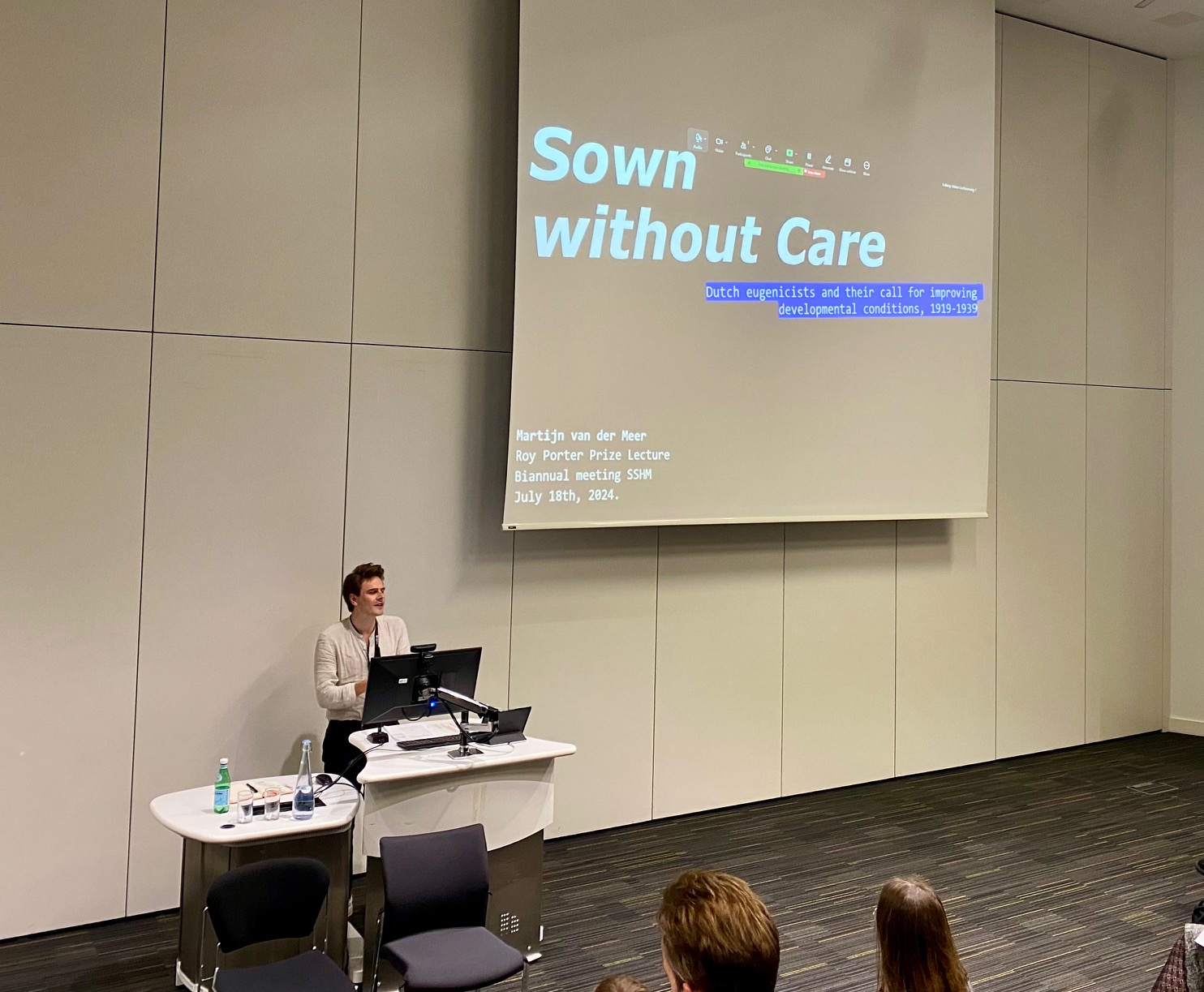
The conference SSHM 2024, hosted by University of Strathclyde, was an amazing experience. The keynote itself went well, and during the Q&A, I realized the audience wasn’t testing or judging me. The senior academics were not asking questions to critique me, but to engage in a professional conversation as a community of like-minded academics. They weren’t evaluating me. They wanted to help me.
The journey of the Roy Porter Prize has been extraordinary. Not just because of the award, the money, and the opportunities—okay, this is also kind of nice—but because I finally started to understand something one of my supervisors had been trying to teach me for a long time. Writing publications, giving talks, doing research, and even winning a prize is not about proving yourself. Academic work is not about individual achievement. It is about contributing to and sustaining an international community of researchers who help each other grow—one that transcends the increasingly shaky institutional structures in which most historians of medicine are working locally.
To anyone considering submitting an essay: do it! The experience is as rewarding as it is humbling. And it’s a reminder that, at its best, academia is a collaborative effort.
The 2024/5 round of the Roy Porter Prize for students and recently graduated doctorates closes at 5pm, 1 February 2025. For prize details, rules, and eligibility, please see: https://sshm.org/portfolio/prizes/.