
Alper Kerem Koşar (Boğaziçi University)
The SHIFA-ANA Workshop: Death and Disease in Anatolia was held on 11–13 June 2025 at Koç University’s Anatolian Civilizations Research Center (ANAMED). As the inaugural workshop organized by the SHIFA-ANA Project, it convened researchers exploring issues related to death, disease, and healing in Anatolia and its wider regional context.
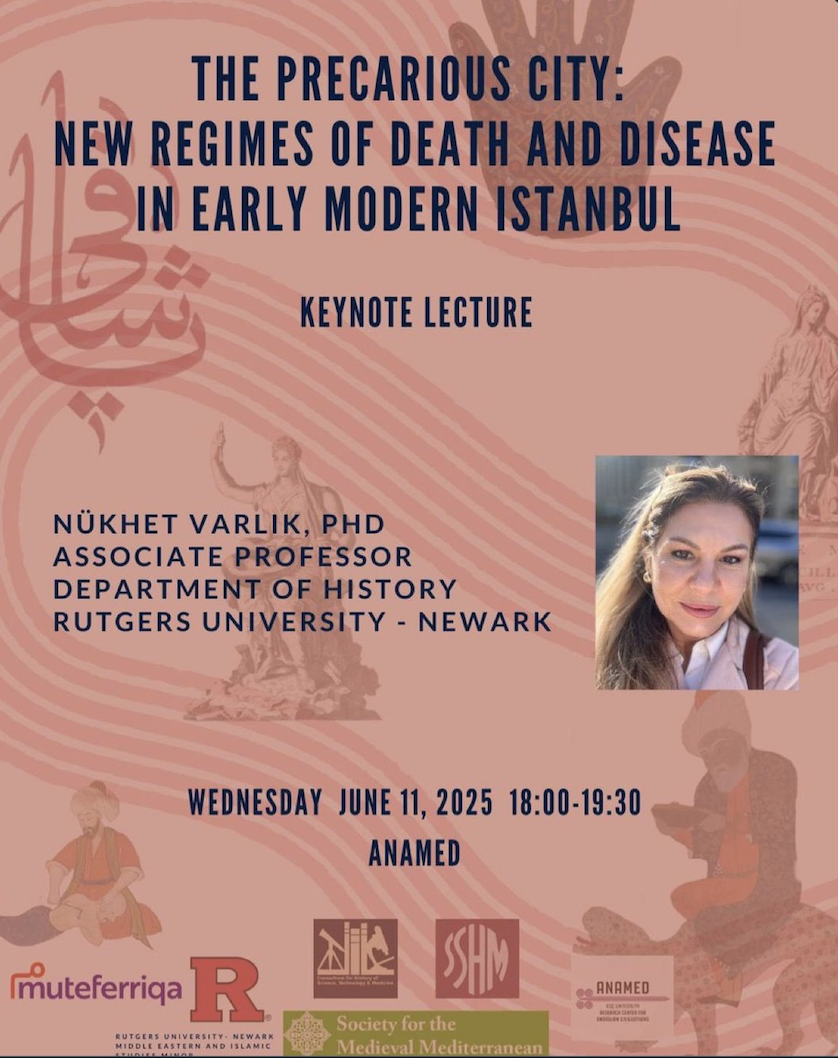
The workshop followed a lecture series organized by the SHIFA-ANA Project between October and June and was held at ANAMED. The keynote lecture was delivered by the project coordinator, Dr. Nükhet Varlık, who examined the factors that profoundly shaped daily life in the early modern period—factors that, in turn, influenced patterns of disease, treatment, and mortality. Varlık also emphasized the importance of posing new research questions to facilitate a deeper understanding of the history of disease and death.
The first session, chaired by Nükhet Varlık, was titled “Scaling Crisis: Empire, Environment, and Epidemics” and focused on epidemics and crises across different regions of the Ottoman Empire. John Curry, who delivered the first presentation, highlighted the challenges faced by the Ottoman Empire during the General Crisis of the 17th Century, such as epidemics, rebellions, and wars. Antonis Hadjikyriacou, presented his paper on settlement dynamics in Ottoman Cyprus, employed Geographic Information Systems (GIS) to display how settlements shifted over time and to reveal the relationship between this mobility and factors such as wars and malaria outbreaks. Alp Eren Topal presented collaborative research with Einar Wigen and Carlo Trombino on the 1812 plague, one of the most severe epidemics in the history of Istanbul. Benan Grams challenged the assumption that epidemics always spread inland via sea routes and ports, with her study of the 1848 epidemic in Damascus.
The second session, chaired by Ayşe Ozil and titled “Doing Public Health: Materialities, Practices, and Regulations,” began with a presentation by Elif Bengüsu Arık, who discussed changing ophthalmic care practices in the Ottoman Empire during the 19th century. Akif Ercihan Yerlioğlu examined transformations in Ottoman medicine in the 17th and 18th centuries, exploring their causes and contexts. He emphasized that during this period, physicians and pharmacists both incorporated new methods and knowledge into their treatments and reevaluated existing knowledge to adapt to changing conditions. Berrak Burçak offered insights on an Ottoman taxation law concerning the city of Bursa from the early 16th century, with the history of disease and public health perspectives. Following this session, Burçak Özlüdil conducted a workshop titled “Death and Disease in Digital History.”
The third session, titled “Necrogeographies & Necropolitics I: Death in the City,” was chaired by Lâle Can. Linda Ratschiller Nasim presented her paper on hospitals established by the British and French armies in Istanbul during the Crimean War, focusing on the treatment of soldiers and associated funeral practices. İsmail Yaşayanlar’s paper examined how policies and practices regarding funerals and cemeteries changed in the 19th century Ottoman Empire. Can Gümüş-İspir explored the conflicts and compromises between city residents and the modernising state apparatus in Istanbul during the same period over the burial of the dead, funeral rituals, and cemetery management.
The fourth session, chaired by Ebru Aykut, was titled “Necrogeographies & Necropolitics II: Archives of Death.” The session started with Aliye Öten’s presentation on gravestones of a cemetery in Istanbul. Yasemin Ayyıldız examined 19th century death records, shedding light on the growing influence of the modernising Ottoman state on daily life. Murat Ergin presented his paper on death notices published in Turkish newspapers and their representation of various social identities. Aslı Zengin discussed the contemporary death recording policies in Turkey, and the challenges related to this policy in the aftermath of the destructive February 2023 earthquakes in Turkey.
The fifth session, chaired by Akif Ercihan Yerlioğlu and titled “Between the Living and the Dead: Liminalities and Afterlives,” opened with Hüseyin Göcen’s paper on vampire cases in the Ottoman world. Göcen examined practices related to vampirism, plague, and burial among rural communities, drawing on evidence from various fatwa records. Anahit Galstyan, in her presentation based on Armenian sources from the 12th and 13th centuries, highlighted that the graves of religious figures and sacred relics were regarded as sites of healing by the living. Meyçem Ceren Ulu discussed the European fascination with ancient Egyptian mummies in the 19th century and considered the role of Ottoman museology in this context. She also addressed ethical debates surrounding the display of human remains in museums and the evolution of curatorial practices from the 19th century to the present day.
The second day of the workshop began with the sixth session, titled “Spaces of Death, Disease, and Healing,” and chaired by Gülhan Balsoy. Hande Altınay presented her research on the quarantine facilities established in Ottoman Iraq during the 19th century, highlighting the experiences and emotions of patients and the ways in which the animals accompanying them endured the quarantine process. Burçak Özlüdil shared her findings on the history of mental health services in the Ottoman Empire, focusing on two hospitals from Istanbul and Edirne as case studies. Zehra Betül Atasoy examined the experiences of Istanbul residents in their neighbourhoods devastated by fires, who continued to live amid the ruins while suffering from diseases such as tuberculosis and syphilis, as well as from poverty.
The seventh session, chaired by Leyla Kayhan, was titled “States of Vulnerability: Young Bodies between Death and Disease.” The session included research on child health spanning a broad timeframe, from the Neolithic period to the modern era. Ali Metin Büyükkarakaya shared data on childhood illnesses and mortality in the Neolithic era, derived from the Tepecik-Çiftlik archaeological excavations in Niğde. Atacan Atakan explored how the child’s body was conceptualised in late Ottoman publications and how the image of the healthy child was shaped by the concepts of hıfzısıhha (health preservation) and terbiye (upbringing). Tuğba Esat Örengül traced the development of child psychiatry in Turkey during the 20th century, drawing on primary sources.
The eighth session, titled “Biopolitics: From Empire to Republic,” was chaired by Cihangir Gündoğdu. Efe Erünal presented his research on the demographic history of Western Anatolia during the 19th and 20th centuries. Focusing on mortality rates, age structure, and urbanisation, he analysed how these demographic patterns evolved over time in the province of Bursa. Merve Kardelen Bilir Uslu, who presented her paper on physical disability, examined how perceptions and legislation on this topic changed throughout the 20th century, in the context of wars and industrialisation. Servando Z. Hinojosa interpreted statistical data on cases of injury and death resulting from falls in Turkey.
The ninth session, titled “Death, Disease, and Healing Across Disciplines,” was chaired by Şima İmşir. Yasin Ilgaz examined the role of the plant Peganum harmala in traditional folk medicine, considering the risks associated with its psychoactive effects as well as its health benefits from a broad perspective. Gizem Sivri approached the Ankara Institute of Public Health from an architectural history perspective, analysing how the building—where tuberculosis vaccine research was conducted—was designed to control pathogens. Ayşe Gülsezer demonstrated the use of visual methods in the study of disease history, with an AI-supported short film on the spread of syphilis in the Ottoman Empire. Remziye Seçen presented a comparative analysis of quarantine policies in the Ottoman Empire and European countries. Batuğhan Tatar emphasised the continuity of death and funeral traditions among nomadic peoples of the Eurasian steppes, based on 13th-century sources.
The tenth session, chaired by Özge Ertem and titled “Burdened Bodies: Anger, Madness, and Disability,” began with a presentation by İrem Yıldız on ophthalmic care. Yıldız examined the role of diseases such as trachoma, smallpox, and syphilis in causing blindness in the Ottoman Empire, as well as the medicalisation of eye diseases. Burcu Belli explored the medicalisation of madness, the rejection of traditional treatment methods, and the adoption of modern psychiatric approaches within the context of Ottoman modernisation. Yağmur Çelik, who presented the final paper, analysed the portrayal of anger in 16th century writer Kınalızade Ali’s Ahlak-ı Alai, combining perspectives from the history of emotions and the history of medicine in early modern Ottoman thought.
In the evaluation session, Koray Durak discussed the conceptual challenges of studying the history of illness and death together, and noted that the term “Anatolia,” chosen as the focus of the workshop, has carried different meanings throughout history. Faisal Husain emphasised that illness and death are universal realities and should be examined not only in biological terms but also in their social, economic, and political dimensions. Anna Akasoy highlighted the importance of incorporating animal perspectives more fully in research on illness and death. Ayşecan Terzioğlu stressed the necessity of considering concepts such as gender, age, class, and disability in research, alongside the value of engaging with art, literature, and popular culture.
This three-day workshop brought together 50 researchers with diverse perspectives and interests, shedding light on the numerous aspects of death and disease in Anatolia and the surrounding world. SHIFA-ANA Project hopes to continue such organizations to further the study of death and disease.