
Mai Thi My Vi (National Cheng Kung University); Krittapak Ngamvaseenont (University of Manchester); Dr Vivek Neelakantan
Report 1
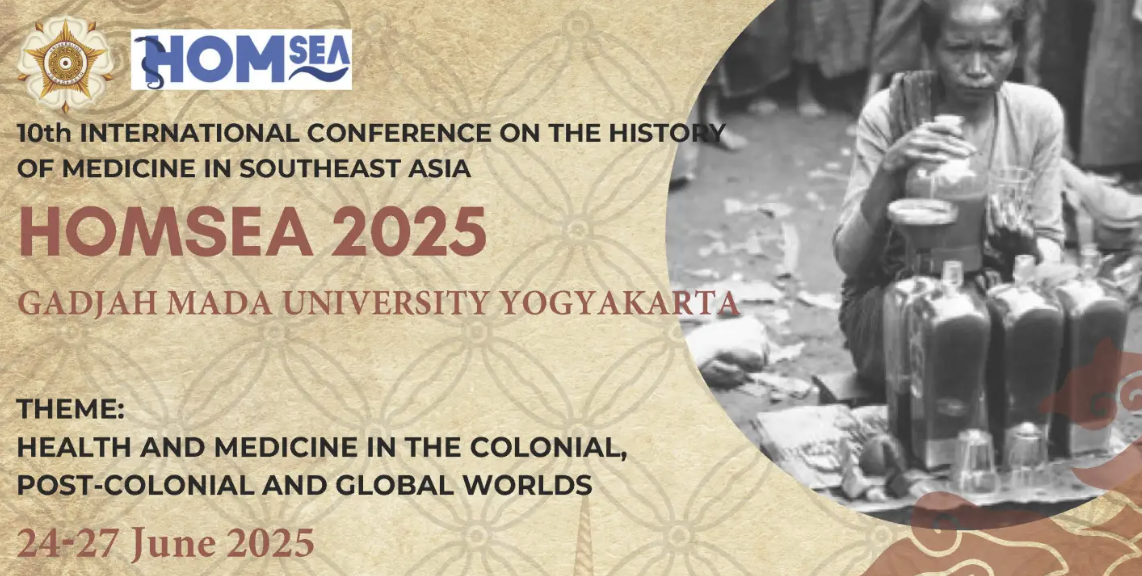
The tenth International Conference on the History of Medicine in Southeast Asia (HOMSEA) was held on 23–27 June 2025 at Gadjah Mada University (UGM) in Yogyakarta, Indonesia. The event brought together over fifty speakers and a larger number of 150 delegates from fourteen countries across Asia, Australasia, Europe, and North America, with sessions spread across the seventh floor of the Soegondo Building of the Faculty of Cultural Sciences (UGM). The panels were distributed over four days with nearly thirty panel sessions, supplemented by workshops, book launches, excursions, and social events that situated medical history within Yogyakarta city, Indonesia’s cultural and institutional landscape.
The conference, organised by the Faculty of Cultural Sciences and the Faculty of Medicine at UGM and the University of Sydney, commemorated ten years of HOMSEA meetings and was kindly sponsored by the Pacific Circle, the Society for the Social History of Medicine (SSHM), and other organisations. To promote interdisciplinary discussion on how historical perspectives can inform current health issues, the organisers, under the direction of Prof. Hans Pols (HOMSEA President) and Prof. Yayi Suryo Prabandari (Local Committee Chair), set the central theme as ‘Health and Medicine in the Colonial, Post-Colonial and Global Worlds’.
Academic Themes and Discussions
The academic programme of HOMSEA 2025 covered various topics from colonial encounters and indigenous healing to public health policies, gender, religion, and traditional knowledge. Prof. Harold J. Cook (Brown University) began the conference with his keynote presentation, ‘Southeast Asia as a Source for European Books on the Medicine of China’. In this remarkable speech, the keynote speaker highlighted the global transfer of medical knowledge, demonstrating how ancient European medical texts on Chinese medicine relied on Southeast Asian intermediaries. The topics of cultural exchange and hybridity in medicine were covered throughout the conference, offering a rich context for the subsequent conversations.
Across many panels, scholars delved into the environmental and social dimensions of medical history. Discussions ranged from the health impact of colonial-era plantation economies to the histories of contagious disease control, mental health, and decolonisation of medicine. The plenary session was highlighted, ‘Health, Health Services, and Medical Education in Indonesia: Learning from the Past, Planning for the Future’. At this symposium, senior doctors and historians gathered to discuss the development of medical education in Indonesia. Presenters examined Indonesia’s medical training from colonial times through independence, and commentators drew lessons for addressing current challenges in the medical workforce and policy.
Social and Cultural Programme
The social programme in Yogyakarta enriched the academic sessions with meaningful encounters beyond the university. On the evening of 24 June, attendees were invited to the Science Art 8.0: Portraits of Inspiring Scientists in Painting exhibition at Fort Vredeburg. The show honoured Indonesia’s scientists through the visual arts and celebrated eighty years of Indonesian independence. The events demonstrated that HOMSEA is important to bridging history, culture, and medicine. On the third evening, delegates toured the Sonobudoyo Museum, exploring Javanese artefacts and history before enjoying dinner at a heritage restaurant and a wayang kulit (shadow puppet) performance in the courtyard. The Historical Hospital Tour was a full-day excursion that took delegates to four historic institutions around Yogyakarta: Bethesda, the former Petronella Zending hospital founded in 1901; the Dr Yap Eye Hospital, established in 1923; Panti Rapih, a Catholic missionary hospital from 1929; and the hospital in Klaten that sustained medical education during the late 1940s conflict. Standing in these century-old buildings, participants reflected on the enduring legacies of colonial medicine still visible in the region. This excursion literally placed delegates inside historical spaces, reinforcing key conference themes.
Atmosphere and Organisation
The conference was well-organized and welcoming. The daily schedule was packed, but everything ran smoothly thanks to careful preparation and the enthusiastic support of UGM student volunteers. The atmosphere was friendly and supportive, with long-time members greeting each other like old friends. First-time participants, including many postgraduate students, were drawn into the fold through discussions that often spilt beyond the allotted sessions. The intimate size of the conference made it easy to strike up conversations, whether debating panel ideas or discovering shared research interests. The Historical Hospital Tour on the final day enhanced networking by visiting many places in Yogyakarta, reinforcing conference themes and fostering new friendships and future collaborations.
Reflections and Outcomes
The academic panels and cultural excursions at the event highlighted the intersection of medicine’s histories with lived spaces and contemporary identities. Delegates discussed the legacy of colonial medicine, focusing on recovering local voices in archives and situating Southeast Asian medical histories within a global framework. The event stressed the importance of synthesis dialogues and structured writing workshops for early-career scholars. The collegial atmosphere fostered collaborations, creating new networks during bus journeys, lunches, and cultural performances. The excursion on 27 June provided fresh insights into medical history and lasting professional and personal connections.
Conclusion
HOMSEA 2025 was a fruitful event that blended academic rigour with collegial discussion and cultural participation. From archival research to comparative and digital analysis, the programme demonstrated a variety of approaches to Southeast Asian medical history, emphasising both local uniqueness and global linkages.
The delegates emphasised the importance of involving more early-career scholars from Southeast Asia and producing collaborative publications or policy-oriented outcomes. The conference’s supportive atmosphere was evident at the closing dinner, where organisers encouraged participants to continue the conversations beyond Yogyakarta, and many people left with new ideas and relationships. I believe HOMSEA 2025 confirmed the scholarly community’s vibrancy and expanding influence while also enhancing my knowledge of the area’s medical history and stimulating more research.
Mai Thi My Vi
PhD. Candidate, Department of History, National Cheng Kung University, Taiwan
Report 2
The Tenth International Conference on the History of Medicine in Southeast Asia 2025 was held at Universitas Gadjah Mada, Yogyakarta, Indonesia. Yogyakarta itself is a city rich in history—from iconic UNESCO World Heritage Sites to colonial-era historical places.
This five-day conference (from 23 to 27 June 2025) was filled with fascinating presentations and engaging historical and cultural excursions. It offered participants a holistic experience of the history of medicine in Southeast Asia, ranging from lecture halls to real historical sites.
The conference featured twenty-seven panels, three keynote lectures, four book launches, and more than 130 presenters from a wide range of countries and institutions across the globe. The main theme of the conference was Health and Medicine in the Colonial, Post-Colonial and Global Worlds. Within this theme, a diverse array of topics was explored. These included the connections and tensions between different forms of knowledge and practice; medicine and decolonisation; the Anthropocene; sustainable development; the environment; medicinal plants; madness; politics; and even art and resistance
A key strength of the conference was not only its focus on Southeast Asian perspectives but also the multiplicity and heterogeneity within those perspectives. Many papers went beyond simply analysing the relationship between Western and local ideas. Instead, they advanced arguments that emphasised the dynamic interactions among various regional and local traditions in the broader exchange of knowledge between the West and Southeast Asia.
It is also worth mentioning that a significant number of papers adopted a transnational approach, which added complexity to their analyses. While the majority focused on contexts within Maritime Southeast Asia, the conference also ensured substantial representation of research on Mainland Southeast Asia.
In addition to the intellectually rich presentations, the conference brought together scholars and experts from a range of disciplinary backgrounds. Many presenters were trained in history, anthropology, sociology, philosophy, cultural studies, gender studies and the arts. A large number of participants were also practitioners—physicians, psychiatrists, nurses, public health workers, advocates and other professionals in health and mental health fields. This created a genuinely multidisciplinary environment that enabled participants from different backgrounds to engage with the history of health and medicine from a broad and inclusive perspective. It was particularly interesting to observe how the history of medicine continues to attract attention from diverse groups within Indonesian academia. This is a strong indication that the field is expanding in various parts of the world—an encouraging sign for its future development.
The conference experience was rounded off with visits to historical sites in Yogyakarta, including Panti Rapih Hospital, Dr Yap Eye Hospital, Bethesda Hospital and Soeradji Tirtonegoro Hospital. Each site offered rich historical and cultural insights. Cultural and artistic events were also held on most evenings, adding further depth to the conference experience.
Importantly, the event brought together scholars from around the world who share an interest in the history of health and medicine in this region. It provided a vital opportunity for early-career researchers to build academic networks and exchange ideas. Many leading and senior scholars in the field also attended, making it an excellent platform for academic discussion and potential future collaboration.
I would like to express my sincere appreciation to the History of Medicine in Southeast Asia (HOMSEA) for organising this conference; to Universitas Gadjah Mada for being such a generous host; to the Society for the Social History of Medicine (SSHM) for supporting postgraduate students; and to all other organisations that helped make this remarkable international academic event possible in Southeast Asia.
I look forward to the next International Conference on the History of Medicine in Southeast Asia and hope it will offer yet another meaningful academic experience.
By Krittapak Ngamvaseenont (he/him) | PhD Researcher | Faculty of Biology, Medicine, and Health | Centre for the History of Science, Technology, and Medicine | Simon Building 2.54 | Brunswick Street | Manchester M13 9PLEmail: krittapak.ngamvaseenont@postgrad.manchester.ac.uk
Report 3
Co-organized by the University of Sydney and Universitas Gadjah Mada, the Tenth HOMSEA Conference provided an interdisciplinary platform to reconceptualize Southeast Asian medical history through colonial, postcolonial, and planetary health perspectives. Thematic clusters explored the afterlives of colonial medicine, community-centered health models versus individual care, environmental degradation, planetary health, ethics, and global health diplomacy. The panels were as diverse as they were engaging—ranging from critiques of humanitarian aid (Vivek Neelakantan and Arnab Chakraborty) to visual narratives and spatial histories of care (Ravando Lie).
Southeast Asia as a Microcosm of Global Health
Once monopolized by the Venetian merchants and later contested by the Portuguese, Dutch, British, French, the quest for spices from the Indies archipelago provided an impetus to three centuries of intra-European rivalries. Southeast Asia’s natural environment—punctuated by the monsoons, volcanoes, dense tropical jungles, and vulnerability to climate change-induced natural disasters—make the region a crucible where resilience, adaptation, and cultural ingenuity are continually tested. As a microcosm of global health—nestled between India to the west and China to the north— the region encapsulates the entwined challenges of Emerging Infectious Diseases, environmental degradation, health inequities, and rapid urbanization. The region’s lived realities at the intersection of ecological fragility and human vulnerability offer a vantage point for reimagining planetary health from the perspective of equitable futures.
Harold Cook’s keynote address was based on a textual analysis of the seventeenth century French medical treatise Les Secrets de la Medecine des Chinois, Consistent en le Parfaite Connaissance du Pouls. The address positionedSoutheast Asia as a source for European books on Traditional Chinese Medicine. Cook’s address prompts a reconsideration of Southeast Asia not merely as a passive conduit through which medical knowledge circulated from China to the West, but as a formative site of cultural translation and entanglement.
Against this conceptual backdrop, case studies from colonial Southeast Asia illuminate the ways in which the region served both as a laboratory and battleground for competing medical ideologies. For example, in the Netherlands Indies, quarantine stations, segregationist spatial logics, and campaigns against infectious diseases such as leprosy, cholera, and trachoma reflected underlying imperial anxieties about racialized disease vectors and justified urban restructuring. A number of presenters drew attention of the audience to the underlying colonial logics of surveillance and behavioural regulation that had been shaped during the colonial era and had been repurposed during the post-World War II era, coinciding with Cold War and the ascendance of modernization.
The author chaired a panel on mental health. Bayu Adiputro and Fajar Wijnarko introduced the audience to the Javanese notions of waras (wellness) and edan (madness) and the interplay between spiritual, social, and psychological dimensions of mental health, a theme reiterated by Krittapak Nganvassenont’s paper. The common denominator underlying Boontariga Puangkham and Krittapak’s presentations that examined the history of Thai psychiatry during the Cold War was the tension between Western concepts and Thai values in mental health. The Javanese and Thai cases illustrated a tension between Western psychiatric frameworks and local epistemologies of mental illness.
The Way Forward
The conference underscored the relevance of Southeast Asia to global health both as a historical crucible and a contemporary frontier. Case studies from the region—from the quarantine stations of the Netherlands Indies to Cold War-era psychiatric paradigms in Thailand—revealed that Southeast Asia’s medical pasts were not relics but were sites of contestation, negotiation, and transformation.
What emerged from the heterogenous panels was a shared commitment to decentring biomedical paradigms and foregrounding indigenous cosmologies of psychiatry, whether through the Javanese notions of waras and edan, or rural Thai psychiatry. These case studies contest the presumed universality of Western medicine.
Equally compelling was the need to bridge historical inquiry with the exigencies of planetary health. As Southeast Asia grapples with natural disasters accentuated by climate change, zoonotic spillovers, and rural migration, its historical experiences with disease not only serve as cautionary tales but also serve as archives of resilience and innovation. The region’s entangled histories of colonialism, migration, nationalism, and environmental change demand a historiography of medicine that is not only interdisciplinary but also justice-oriented.
In sum, HOMSEA 2025 did more than convening scholars. It catalysed a reimagination of medical history as a tool for shaping equitable futures. It affirmed that to understand the past and the future of global health, we must listen to plural voices, especially when it speaks in many tongues, across many islands. In this context, a regional perspective on international health is not merely additive. It offers nuanced insights that challenge universalist assumptions of intergovernmental organisations such as the World Health Organisation (WHO) and illuminate pathways toward a context-sensitive health future.
Dr Vivek Neelakantan