
Written by Alessandro Bianchi, Newcastle University (Report 1)
I had the pleasure of attending the ‘Life Histories in Mind: Mental Ill Health and Learning Disability in Context’ conference, held at Manchester Metropolitan University on 21–22 July 2026. This conference was organised by Dr Rebecca Ball, Dr Rob Ellis and Leonie Chesworth, and gathered thirty-six speakers across thirteen sessions, including two wonderful keynotes by Prof. Catharine Coleborne and Dr Jane Stockdale. The event was funded by the Histories of Race, Gender, Sexuality and Identity (RGSI) group of Manchester Metropolitan University, the Social History Society and History UK, and supported by the Cultures of Disability and Health group and the Manchester Centre for Public Histories and Heritage of MMU.
The conference explored the intersection between life histories, mental illness and health, and learning disabilities. It accordingly sought to recentre human experience—that of doctors, patients, or individuals with learning disabilities—within historiographical discussions concerning treatment, disease and disability.
The papers presented at the event engaged with these thematic encounters across a significant geographical and temporal variance. Talks encompassed five continents and spanned from the eighteenth to the twenty-first centuries. Such diversity incited speakers to observe transnational and temporal links in medical practice and the experiences of convalescents.
The themes that emerged across talks and discussions pertained to the fields of ethics, positionality, and navigating challenges. The two keynotes were instrumental in eliciting such considerations.
Inspired by Prof. Coleborne’s introductory paper on ‘Aftercare Lives’, wherein she utilised pseudonyms as a means of maintaining the anonymity of patients, Dr Ellis brought the issue of the ethics of naming patients into the discussion of panel B1 on ‘Embodied Suffering, Institutional Power’. The panel’s focus on nineteenth-century sources allowed for considerations to move beyond the crux of legal access to case-files. Providing the real names of patients humanises them in full, speakers and audience-members agreed, but has to be balanced with the desires of family members and respect for the individuals themselves. Dr Stockdale crystallised this tension between privacy and personalisation through her keynote on ‘Life Histories in the Museum’: within it, she explored how the museum is a space that requires one to negotiate representations of mental ill health, receptiveness to the voices of visitors who have had experiences of institutionalisation or mental illness, and interfacing with administrative regulations and tensions. Panel B4, ‘Beyond the Archive’, saw speakers engage with a further ethical issue beyond access and anonymisation: what should one share? During the discussion, presenters stressed that some accounts can be damaging if made public; the inclusion of certain clinical or personal details, indeed, can at times be more dehumanising than silence.
Panel A5, ‘Insights into Patient Lives’, was deeply linked to questions of ethics and was particularly engaging. Discussions concerning the experience of anthropological work in rehabilitation centres, following Dr Tuhina Ganguly’s presentation, spoke to the challenges and opportunities of working with living people compared to archival sources. Moreover, Sarah Bergman foregrounded the need for researchers to acknowledge and actively engage with their own emotional responses to and positionality vis-à-vis life histories, providing means of addressing the tensions that can emerge when engaging with medical cases and the personal experiences of patients. Perhaps the greatest proof of the power in such self-awareness can be found in Lisa Edwards’s paper, in which she explored her own family’s history of institutionalisation and its rippling effects across generations. I must confess that her presentation in particular, together with that of Dr Helen Atherton in panel B4, struck and moved me.
Whilst talks primarily centred on patient experiences, Drs Rebecca Wynter and Len Smith emphasised the need to pluralise such narratives by investigating ‘Woman Patients and Proprietors’. Speakers on panel B2, ‘Revolutionary Life Stories in Mind’, also expanded the lens of analysis by linking individual mental ill health to broader political developments. The final panel on ‘Defining and Diagnosing (In) Capacity’ was thus a perfect note to end with, as it reiterated a fundamental challenge in our field: Amberlea Jones and Prof. Sonu Shamdasani reminded audience members that doctors themselves were struggling with diagnostic categories, and often genuinely endeavoured to engage with the idiosyncratic circumstances of their patients.
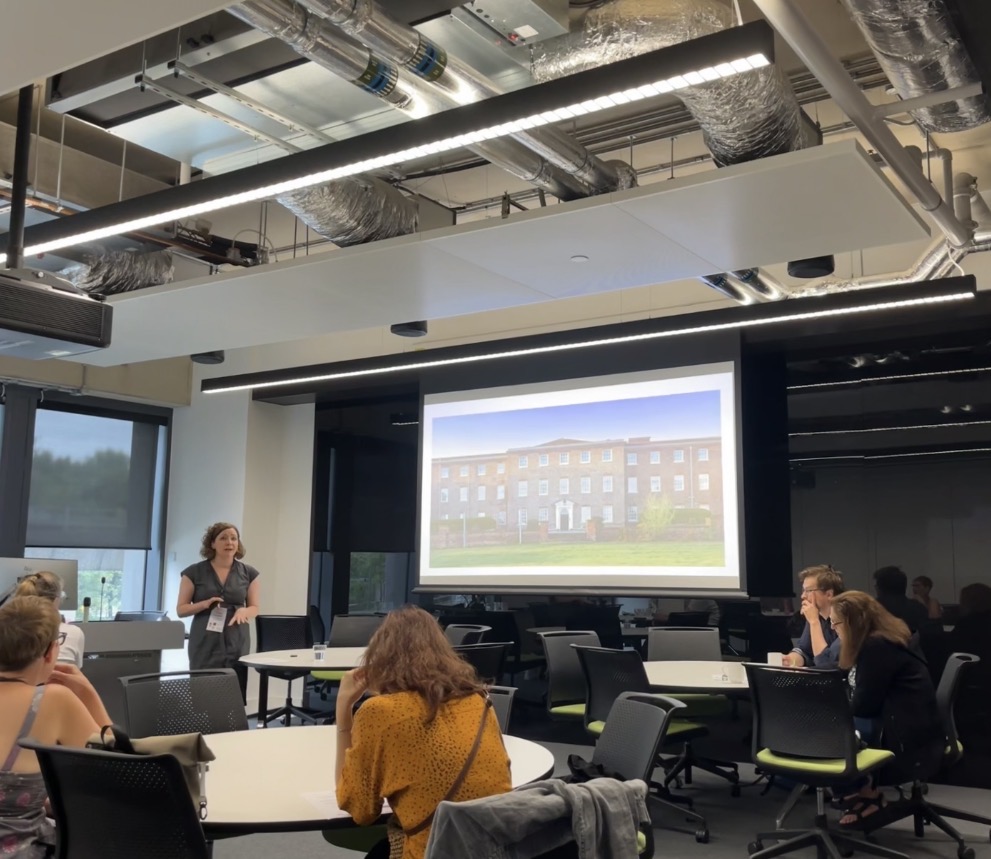
Beyond the panels themselves, there was a feeling of conviviality across the conference. The event had a wide range of speakers and at times felt quite daunting, yet the conference still felt rather intimate. In part this was an effect of the Dalton Building, whose wide glass panes and open space provided airiness and a scale that was equal parts welcoming and imposing. The seminar rooms and lecture hall, on the other hand, were sizeable yet cosy. The humdrum of conversation pervaded the building during coffee and lunch breaks, which were captivating opportunities for us to discuss the papers presented, share research, and pick one another’s minds regarding the current state of academia. It was lovely to meet so many brilliant academics, and I also had the pleasure of speaking a bit of Italian.
Dr Atherton prepared a touching exhibition entitled ‘Finding Ivy’, which speakers could explore during coffee breaks. It focused on the patients who, though originally born in England, were ultimately victims of the Aktion T4 program in Nazi Germany.
Punctuated by an engaging evening social event at the Rain Bar, and a final drinks reception, the conference was a great success. The organisers have expressed their interest in producing an edited collection from the papers presented at this conference.