
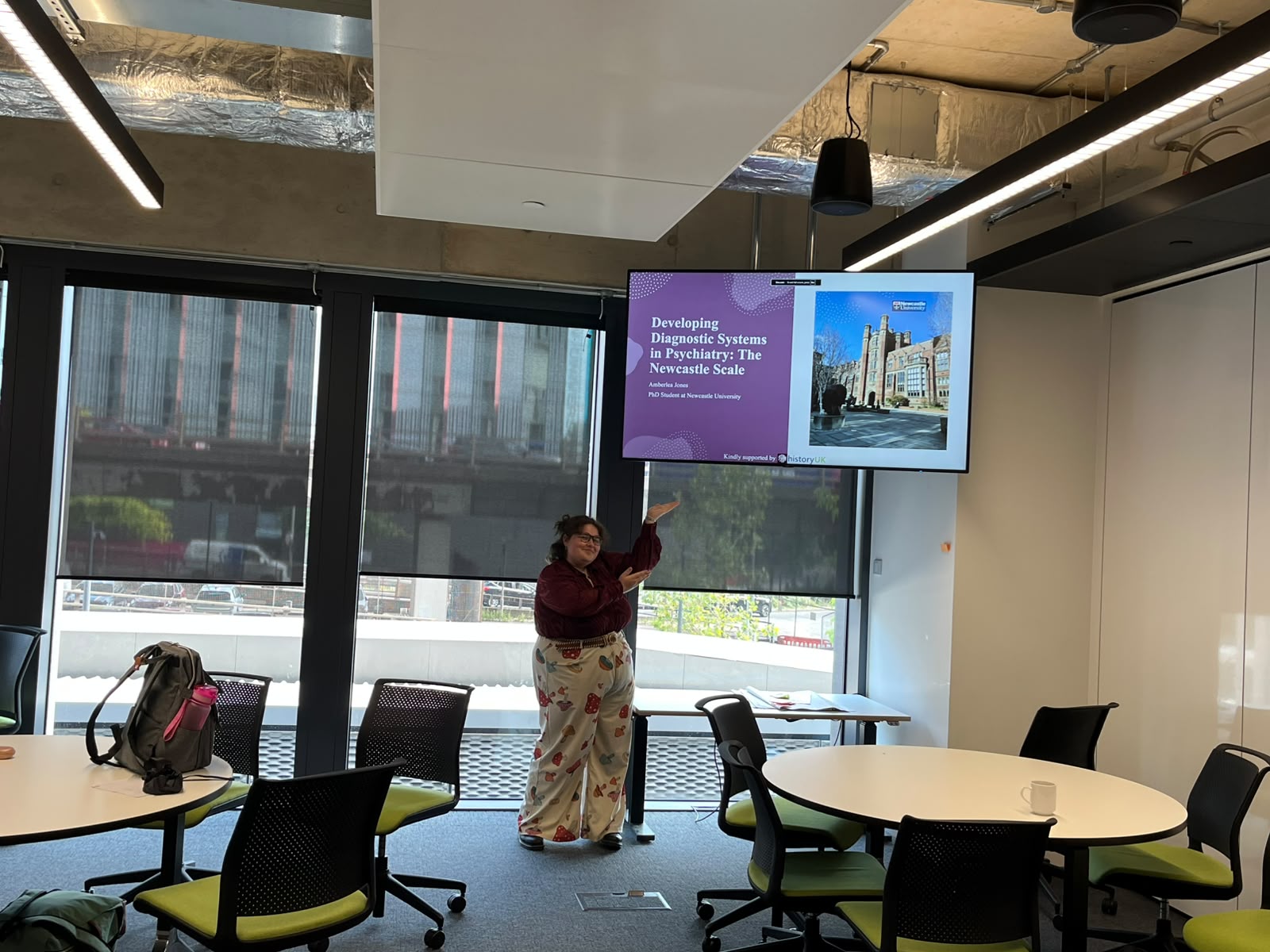
Written by Amberlea Jones, Newcastle University (Report 2)
On 21-22 July 2026, I had the pleasure of attending “Life Histories in Mind: Mental Ill Health and Learning Disabilities in Context,” at Manchester Metropolitan University. The two-day event was excellently organised by Dr. Rebecca Ball and Dr. Rob Ellis, with the invaluable help of Leonie-Mae Chesworth. The conference was supported by funding from the Histories of Race, Gender, Sexuality and Identity (RGSI) at Manchester Metropolitan University, the Social History Society and History UK. Additional support came from the Manchester Centre for Public Histories and the Cultures of Disability Past and Present. My attendance was made possible by funding from the Society for the Social History of Medicine.
“Life Histories in Mind,” was intended to highlight the experiences of those involved with mental ill health and learning disabilities beyond medical records or institutional lists. The aim was to bring in the complexities of life histories and how we ascertain these to the forefront of research. Discussions of service users, doctors and families highlighted facets of mental health and learning disabilities, covering periods from the 18th and 19th centuries to the present day, allowing for an interesting overview of how access to these histories is ever-changing. The conference was divided into eleven panels of over thirty speakers across two days. Alongside this were two particularly excellent keynote speakers, Professor Catharine Coleborne and Dr. Jane Stockdale.
Professor Coleborne’s presentation on “Aftercare Lives in the Twentieth Century,” was an incredible beginning to the two days. During a discussion on the lives of those leaving institutions in the early twentieth century, one particularly interesting point stood out from this talk: the realisation that for service users, success was not dependent on complete independence but a consistent programme of help and support. This is something I think still rings true in modern mental health care, regardless of location, and is something I hint at in everything I write. Moreover, Dr. Jane Stockdale’s presentation on the Mental Health Museum in Wakefield was an intriguing look into how we present life histories to the wider public when mental ill health is something so personal to many. I was particularly interested in the way the researchers at the museum go out of their way to collect the life histories of people today, specifically throughout the AHRC-funded “Asylum: Refugees and Mental Health,” project. Every panel was of high quality and interest, however, two stood out to me for their relevance to my research. Firstly, panel A1: “Narrating Minds: Lived Experience, Institutions and Deinstitutionalisation,” chaired by the lovely Effie Karageorgos, was a highlight of the two days. Rebecca Ball, Irene Geerts and Amy Hall gave three completely individual talks on first-person narratives in the twentieth century in the era of deinstitutionalisation. Together, this panel functioned perfectly, giving an overview of the life histories of people in a multifaceted approach across those who received formal healthcare, those who didn’t and those who watched their loved ones experience the system. Moreover, panel B4: “Beyond the Archive: Digital Representation, Visibility, and the Reimagining of Mental Health Histories,” chaired by the wonderful Leonie-Mae Chesworth, was another standout for me. The return to how we translate lived histories to the public now was covered by Carolyn Donohue who discussed the York Retreat and current visions for presenting the history of this iconic British institute of mental health care. Cecilia Rodéhn provided an incredible insight into how we can integrate the teaching of these life histories at university level with her module, where students had to create structures based on the life histories they study. Finally, a standout talk was Helen Atherton’s “Finding Ivy: A life worthy of life,” that was accompanied by an exhibition to look at whilst having coffee. This talk was one of the hardest to listen to, yet necessary; the raw experiences of people still affected by the discrimination of learning disabilities and mental ill health by Nazi Germany and the development of Aktion T4 was a reminder of how many life histories we have yet to uncover.
Truly, this conference was the highlight of my PhD experience so far. The atmosphere was friendly and everyone was highly interested in everyone’s work. There was a concerted effort to make connections and support the researchers during presentations. The two days consisted of a wealth of intellectual conversations and community, and many remarked on the joy gained by being in a group of likeminded researchers in this field. The specificity of the conference allowed for a deeper understanding of the issues we, as interdisciplinary researchers, face when writing or talking about these life histories and the care it requires. Attention focused on discussions of pseudonyms and ethics surrounding this, and though a clear answer was not found, the individual experiences of others allowed for deeper thinking on the subject. For me, discussions surrounding the terms “service user,” and “patient,” were enlightening as I’m conscious of this in my own research. The evening event at the Rain Bar in Manchester allowed for another lovely social event where networking and discussions were encouraged. The atmosphere was welcoming, kind and there was a clear sense of community being created, one that we’d love to revisit in future conferences of this type.
The organisers expressed interest in creating an edited collection on the theme of this conference, something that I am keen to add to and share with you all in the future. Thank you again to everyone involved in such a positive few days.