
By Samuel Goldstone-Brady, Alexandra F Morris, Louise Bell, Kirstie Stage, and Alice Conibere.
Across 2024 and 2025, the UK Disability History and Heritage Hub (UKDHHH) organised two networking events to connect academics, researchers, heritage professionals, artists, activists, and others interested in histories of disabled, neurodiverse, and D/deaf people.
The UKDHHH was founded in 2022 by a group of then PhD students who wanted more opportunities to connect. We felt there was space for a network that could capture the range of activities and projects across the medical humanities and other fields concerned with disability history. Following the conference ‘Invisible & Under-Represented? Disability History, Objects & Heritage’ in March 2022 and monthly online discussion groups, in 2023 we decided to pursue larger opportunities. In particular, we wanted to ensure that our future efforts were inclusive and accessible to a broad audience. This resulted in our vision of yearly ‘Connecting + Sharing’ events, and an application to the Society for the Social History of Medicine (SSHM) Network Funding scheme supported by the Wellcome Trust.
With the support of the SSHM and another networking fund from the Northern Network for Medical Humanities Research, we were able to fund two ‘Connecting + Sharing’ events. We hosted the first of these as a hybrid conference on 6th June 2024, located at the Manchester Deaf Centre. Then on 25th June 2025, we hosted the second event as an entirely virtual conference from our own Zoom account.
UKDHHH Connecting + Sharing Event – Thursday June 6th 2024 @ Manchester Deaf Centre
Our first Connecting + Sharing event was attended by around 50 people in-person (including presenters, UKDHHH Team, and interpreters) and 30 online (attendees only).
The event consisted of 22 5-minute in-person presentations. Our concept was based around multiple short presentations, which would allow us to include a wide range of individuals, projects and organisations at the event, and encourage collaboration across fields and industries.
We had five session slots, based around different themes:
· Arts, Activism, and Organising included presentations about HIV activism, artistic responses to disabled mill workers, and histories of disability rights campaigning.
· Interpreting Sources and Accessing Archives highlighted projects with organisations such as the Disabled People’s Archive and Graeae Theatre Company.
· Researching and Presenting Disability, Deaf and Neurodivergent Histories was made up of PhD and academic research. Topics included the social integration of ex-servicemen with hearing lost after 1914 and Helen Keller at United Service Organisations in America.
· Material Culture and Museum Experiences included presentations about co-curating disability history narratives in museums and experiences of the Curating for Change fellowship.
· Disability, Deaf and Neurodivergent Histories in the Heritage Sector continued the themes of the prior slot with presentations about mental health in museums and an access pilot programme at Leeds City Museum. We ended the day with a rousing presentation about the need for a museum of disability history in the UK.
We received positive feedback from the event, as people enjoyed the 5-minute presentation slots as an opportunity to learn about new developments within the field. However, others reflected that five minutes wasn’t enough for some presentation topics!
A core focus of the day was accessibility. We hired the Manchester Deaf Centre as an academically neutral space with excellent provisions for d/Deaf attendees and few physical access barriers. We used funding to hire an additional room as a quiet space and to provide lunch for attendees. We also assisted a limited number of in-person attendees with travel bursaries to reduce transport friction. Finally, we hired two British Sign Language (BSL) interpreters and two Speech-to-Text Reporters (STTR) for the event. Ensuring a good technical set up for the event was a major learning curve – for instance, we found ways to display captions for both audiences simultaneously – on screen for virtual attendees and on a large TV screen for in-person attendees. This experience has taught us a lot about best practice for true inclusivity in hybrid events.
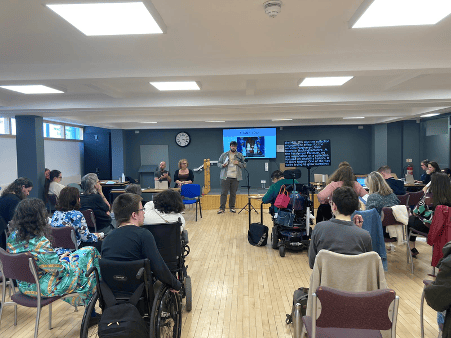
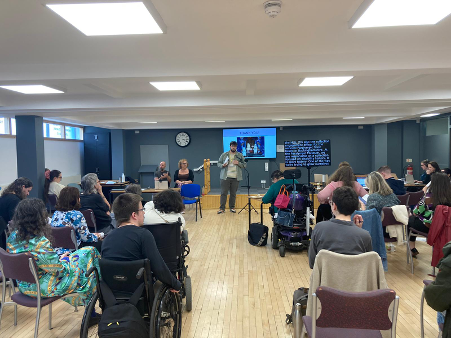
Samuel Goldstone-Brady introducing the last panel of the 2024 Connecting + Sharing Event – Disability, Deaf and Neurodivergent Histories in the Heritage Sector.
Alt Text: A man speaking into a microphone in front of a group of people. He is standing, facing the camera, whilst the audience in the image are sitting facing away from the camera. The atmosphere in the room is calm and engaged. Behind the presenter is a screen with the words ‘Thank you’ displayed at the top. To his right are two other people facing the audience – one of them is making an action with their hands, which we know to be British Sign Language. To the presenter’s left there is another screen displaying captions.
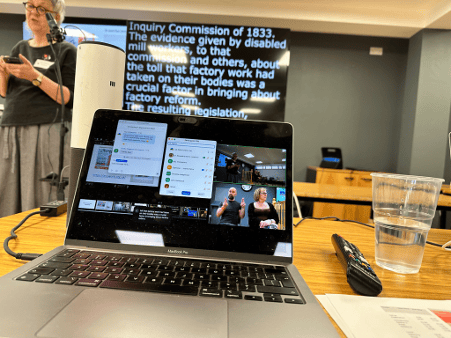
Zoom set up for hybrid set up for 2024 Connecting + Sharing Event – captured during Gill Crawshaw’s presentation: ‘Any work that wanted doing: an artistic response to research into disabled mill workers.’
Alt text: The focus of the image is a laptop screen, which displays a Zoom video call window. There are multiple things happening on the screen – a rectangle featuring the British Sign Language interpreters, a window for presentation attendees, a window for the Zoom chat, and an obscured screen share of presentation slides. In the background behind the laptop is a television screen displaying captions for the event. To the left of the image is the presenter Gill Crawshaw, who is reading off a phone and speaking into a microphone.
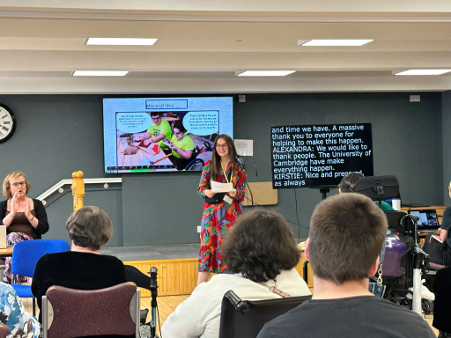
Kirstie Stage speaking during the 2024 Connecting + Sharing event close.
Alt Text: A woman speaking into a microphone in front of a group of people. She is standing, facing the camera, whilst the other people in the image are sitting facing away from the camera. The atmosphere in the room is calm and engaged. Behind the presenter is a screen with a presentation slide which features an image of two wheelchair users. To the presenter’s right is another person facing the audience – they are making an action with their hands, which we know to be British Sign Language. To the presenter’s left there is another screen displaying captions.
UKDHHH Connecting + Sharing Event – Wednesday June 25th 2025 @ Zoom
For our second Connecting + Sharing event, we decided to run an entirely virtual conference based on logistics and capacity within the team. At the 2025 online event, we had an audience of around 40 people (including presenters, UKDHHH Team, and interpreters).
Following feedback, this year we sought a balance between the previous years’ 5-minute presentation structure and traditional academic papers and panels. We featured 16 presentations, and due to the online nature of the event we were able to extend invitations to presenters from the United Kingdom, United States, Canada, Australia, and Greece.
Highlights included:
· A presentation from the Scottish Deaf Archives about the need for local Deaf histories, and the challenges of sustaining community archives.
· A panel of Australian and Canadian presenters focusing on two projects that involve community and academic partners to advocate for disability justice – ‘My Home, My Rights’ based in Halifax, Canada, and ‘Remembering Disability Institutions’ based in New South Wales, Australia.
· 5-minute presentations about Disability and healing in ancient Greece; language use in the perception of Dwarfism; historical narratives about autism; and inclusive research guides produced by Shakespeare’s Globe.
· A presentation about visual sources related to blind people in printed sources.
Following on from our experiences in the 2024 event, we sought to consider how to make our 2025 event more inclusive for a digital audience. We again hired BSL interpreters and STTRs for the event. We also hired two American Sign Language interpreters and had our Call for Presenters translated into a BSL video which was shared on social media and with Deaf communities. We came across more learning points from this event – such as understanding Zoom’s new interpretation features – but overall this was another successful event!
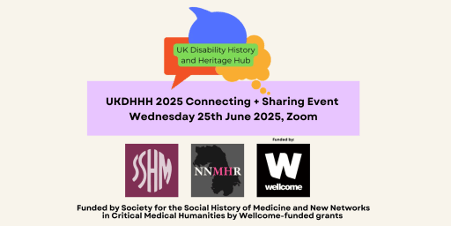
Event banner for 2025 Connecting + Sharing Event.
Alt Text: Graphic for 2025 Connecting + Sharing Event, featuring logos of UK Disability History and Heritage Hub, Society for the Social History of Medicine, Northern Network for Medical Humanities Research, and the Wellcome Trust. Text on the image reads: UKDHHH 2025 Connecting + Sharing Event, Wednesday 25th June 2025, Zoom. Funded by Society for the Social History of Medicine and New Networks in Critical Medical Humanities by Wellcome-funded grants.
Feedback from both events highlighted increased perception of organisations and individuals working in the histories of disabled, neurodiverse and d/Deaf people. Moreover, we found that people working within these histories became more aware of connections with the medical humanities, and of the SSHM in particular.
Without the support of the SSHM, we would not have been able to run both of our Connecting + Sharing events. In particular, the network funding scheme was vital for our efforts to create inclusive and accessible events. We would like to thank the SSHM and the Wellcome Trust for supporting our network and enabling networking within disability history research.